Written by the InclusivePay Merchant Advisory Team | Last updated: April 2026
InclusivePay has been placing peptide merchants with U.S. domestic acquiring banks since 2018. This guide covers what actually happens when aggregators shut down peptide businesses — and the only setup that actually works long-term.
If you’re reading this, there’s a decent chance you just got the email. Account terminated. Funds frozen. No warning, no explanation, no appeal. Or maybe you’re smarter than that — you’re researching before it happens.
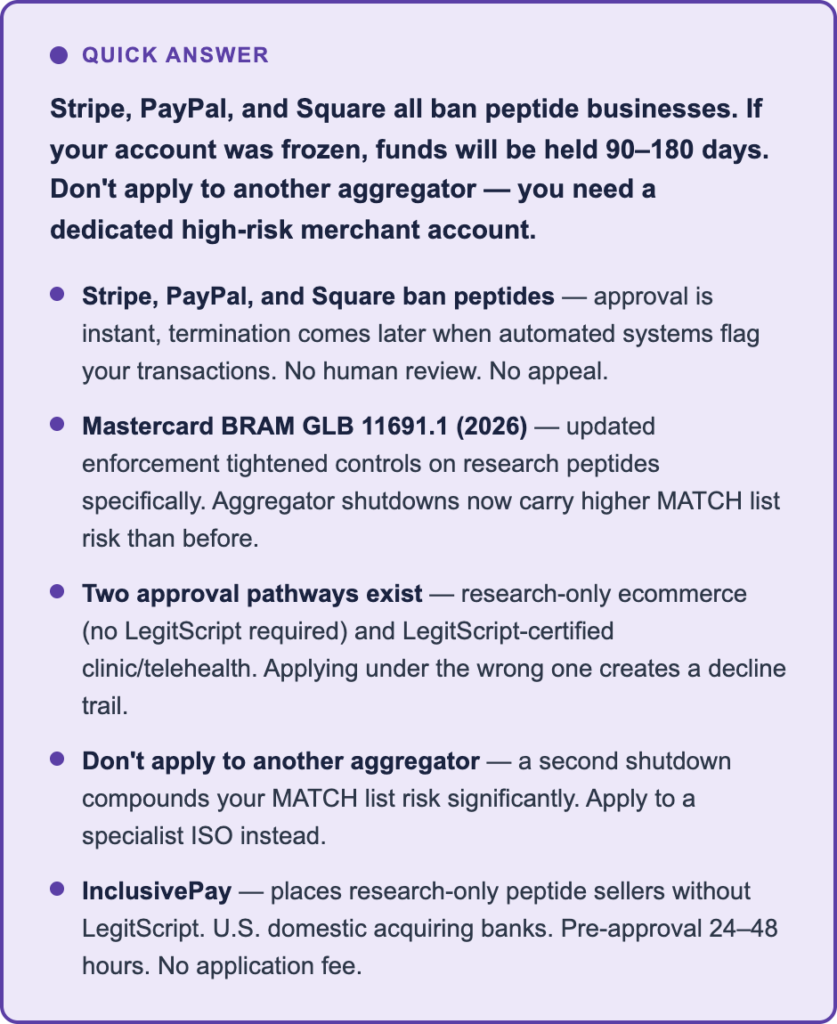
Stripe bans peptides. PayPal bans peptides. Square bans peptides.
What happened to your account wasn’t a mistake. And the fix isn’t finding a smarter aggregator workaround. Here’s what actually is.
What Stripe Actually Says About Peptides
Stripe’s acceptable use policy doesn’t list peptides by name — but it prohibits “products that are frequently associated with illegal activity” and anything in a “gray area” regulatory category. Research peptides tick both boxes in every automated risk system Stripe runs. Add in the 2026 Mastercard BRAM GLB 11691.1 update that specifically tightened enforcement on research peptides and nutraceuticals, and you have a category that every major aggregator’s algorithms are primed to flag.
The reason most peptide sellers end up on Stripe anyway is the onboarding. Stripe approves everyone instantly with no individual underwriting. You get a green light, start processing, and their risk algorithms catch up weeks or months later. By then you may have tens of thousands of dollars in that account.
Real: A research peptide seller processing $18K per month had their Stripe account terminated with no warning. Their $11,200 in pending payouts was frozen for 127 days. They couldn’t reorder inventory, couldn’t fulfill open orders, and had to pause all advertising. Stripe never explained why. Their site was fully compliant.
| Real consequence: Stripe and PayPal hold funds for 90–180 days after termination. You cannot withdraw, cannot process new payments, and may be placed on the MATCH list — a database of terminated merchants that makes future approvals significantly harder for up to five years. |
The 2026 Mastercard BRAM Update Makes This Worse
Here’s something most guides don’t explain clearly enough: the enforcement environment for peptide sellers has gotten harder in 2026, not easier. In 2026, Mastercard updated its BRAM enforcement program (GLB 11691.1) to tighten controls over research peptides, unapproved pharmaceuticals, and nutraceuticals.
The practical effect: processors that previously had looser standards for peptide accounts are now applying stricter underwriting — or exiting the category entirely. An aggregator shutdown today is more likely to result in a MATCH listing than it was two years ago. The wave of displaced merchants after major shutdowns in early 2026 has every acquiring bank on higher alert for peptide applications that look rushed or non-compliant.
This means applying under the wrong pathway — rushing into another aggregator after a shutdown, or applying to the wrong type of specialist processor — is more consequential now than it was before. Take the time to apply correctly. It matters more in 2026 than it ever has.
The Two Approval Pathways — and Why This Matters
Here’s something almost no competitor explains clearly enough for a merchant to act on: there are two legitimate approval pathways for peptide businesses, and they lead to completely different requirements, processor options, and outcomes. Applying under the wrong one wastes time and creates a decline paper trail that complicates future approvals.
Pathway 1: Research-Only Ecommerce (Most Common)
For online stores selling peptides strictly labeled “for research purposes only” with no clinical or therapeutic framing. This is the most common model and the one InclusivePay works with. LegitScript is not required for this pathway. What is required: “for research purposes only” on every individual product page, sitewide footer disclaimer, no human efficacy language anywhere on the site (including blog posts and FAQs), scientific or technical product descriptions, and a clean compliant checkout.
Pathway 2: LegitScript-Certified (Clinics and Telehealth)
For medical clinics, med spas, or telehealth platforms dispensing peptides as part of supervised patient care. LegitScript certification is required (~$1,500 upfront plus annual fees, takes 4–8 weeks). This unlocks more processor options and often better rates. Required by Easy Pay Direct and similar processors. Best path for GLP-1 and semaglutide clinical dispensing.
Bottom line: If you’re a research-only ecommerce seller, you do not need LegitScript to work with InclusivePay. If you apply to a processor requiring LegitScript when you don’t have it, that’s a decline — and declines create a paper trail. Contact us before applying anywhere to confirm which pathway fits your business.
What to Do Right Now If Your Account Was Frozen
Order of operations matters here. Do these in sequence.
- Stop processing on any other aggregator: The instinct after a shutdown is to immediately find another platform. Don’t. A second aggregator shutdown in the same category significantly increases your MATCH list risk. Stop the cycle before it compounds.
- Document everything: Transaction logs from the frozen account, the termination notice in writing, all bank statements, current documentation for your products, your business registration. You’ll need all of this for your next application.
- Check your MATCH list status: Not all aggregator terminations trigger a MATCH listing, but peptide shutdowns in 2026 carry higher MATCH risk than they did previously. Contact InclusivePay — we can help determine your status before you apply anywhere.
- Identify your pathway: Research-only ecommerce or LegitScript clinic? Applying under the wrong pathway is a waste of time and creates a decline record. Confirm before you submit anything.
- Apply through a specialist ISO: A dedicated high-risk ISO like InclusivePay actually underwrites your business before approval. The acquiring bank knows what you sell before your first transaction. That prior agreement is what makes the account stable.
What Your Site Needs Before You Apply
Your website is reviewed page by page before underwriting approves your account. In peptides, site language is the most common reason applications are declined — not your products, not your history.
- “For research purposes only” on every individual product page: Not just the footer. Underwriters check each product page individually. A single listing missing this disclaimer is a flag.
- Sitewide footer disclaimer: Recommended: “All products sold on this website are intended for research and identification purposes only. These products are not intended for human dosing, injection, or ingestion.” Every page, not just product pages.
- No human efficacy language anywhere: Blog posts, FAQs, social links, testimonials — all of it. “Promotes recovery,” “helps with weight loss,” “improves performance” — all imply human use and can kill an application.
- Scientific or technical product descriptions: Molecular weight, purity percentage, amino acid sequence, storage instructions, CAS number. These support the research framing underwriters need to see.
- Clear refund policy, privacy policy, terms of service: All three must be live, accessible from every page, and specific to your business. Placeholder policies slow underwriting and sometimes kill applications.
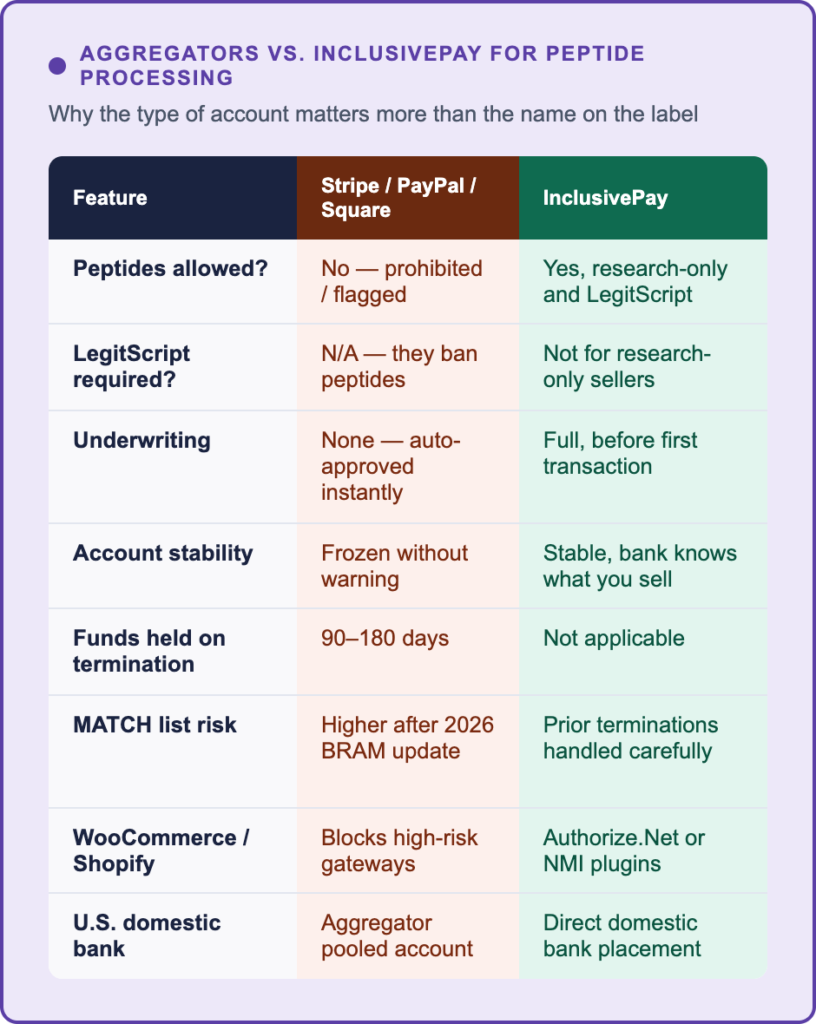
Aggregators vs. InclusivePay for Peptide Processing
| Feature | Stripe / PayPal / Square | InclusivePay |
| Peptides allowed? | No — prohibited / flagged | Yes, research-only and LegitScript |
| LegitScript required? | N/A — they ban peptides | Not for research-only sellers |
| Underwriting | None — auto-approved instantly | Full, before first transaction |
| Account stability | Frozen without warning | Stable, bank knows what you sell |
| Funds held on termination | 90–180 days | Not applicable |
| MATCH list risk | Higher after 2026 BRAM update | Prior terminations handled carefully |
| WooCommerce / Shopify | Blocks high-risk gateways | Authorize.Net or NMI plugins |
| U.S. domestic bank | Aggregator pooled account | Direct domestic bank placement |
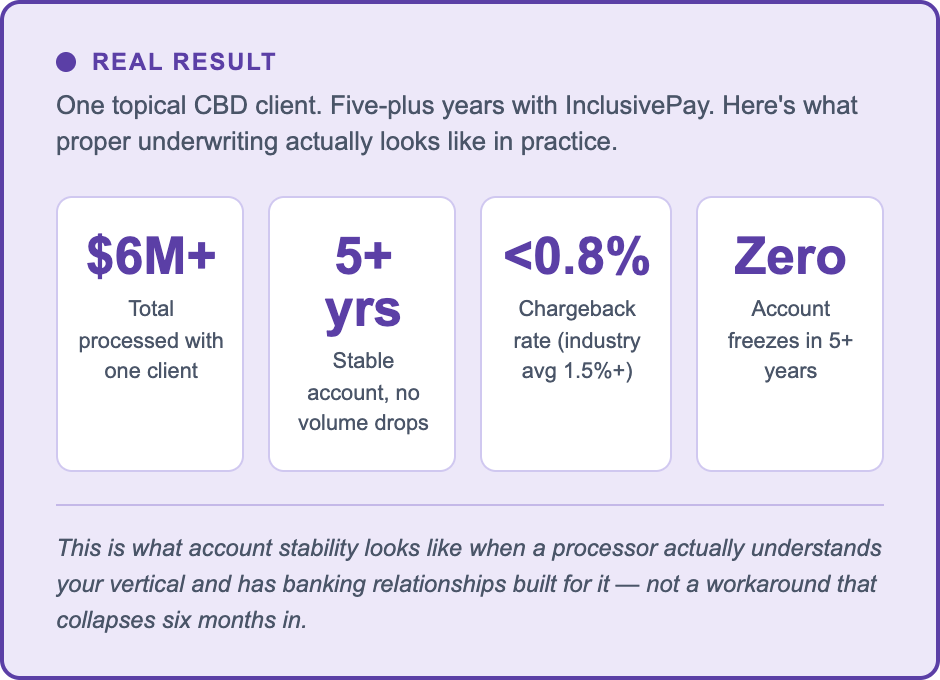
| REAL RESULT One topical CBD brand has processed over $6M with InclusivePay across 5+ years. No volume drops. Chargebacks held under 0.8%. Never frozen. We bring the same underwriting discipline to every vertical we work with, including peptides. |
FAQs
Does Stripe allow peptide sales?
No. Stripe’s risk systems flag research peptides as a prohibited or restricted category. Even if approved initially, it will be terminated when algorithms detect your product category. Funds held 90–180 days. See our guide on what to do when Stripe shuts you down for the step-by-step.
What is the Mastercard BRAM GLB 11691.1 update and why does it matter?
Mastercard’s BRAM (Business Risk Assessment and Mitigation) program monitors high-risk merchant categories. The 2026 GLB 11691.1 update specifically tightened enforcement on research peptides, unapproved pharmaceuticals, and nutraceuticals. Practically, this means more processors are exiting the peptide category or applying stricter underwriting — and aggregator terminations in 2026 are more likely to trigger MATCH list placement than they were previously.
Do I need LegitScript to get a peptide merchant account?
Not if you’re a research-only ecommerce seller. LegitScript is required by some processors but InclusivePay works with research-only sellers without it. See our peptide merchant account page for a full breakdown of both pathways.
What happens to my funds if Stripe or PayPal shuts down my peptide account?
Funds are typically held for 90–180 days after termination. You will get the money back assuming no active chargeback disputes deplete the reserve. Do not continue processing on another aggregator while waiting — this worsens your situation. Contact us to talk through your specific circumstances.
Can I get a peptide merchant account if I was already shut down by Stripe?
Yes. Prior aggregator terminations for peptides are common and don’t automatically disqualify you from a dedicated merchant account. The important things: disclose the termination upfront, don’t apply to another aggregator, and come with complete documentation. If you were MATCH-listed, that changes the conversation but doesn’t eliminate options — contact us to discuss.
What’s the difference between a research-only peptide seller and a LegitScript model?
Research-only: online stores selling peptides labeled strictly “for research purposes only” with no clinical framing. No LegitScript required. LegitScript model: medical clinics, med spas, or telehealth platforms dispensing peptides as supervised patient care. LegitScript certification required (~$1,500 plus annual, 4–8 weeks). Applying under the wrong pathway wastes time and creates a decline trail. See our peptide merchant account page to confirm which pathway fits your business before applying.
Does InclusivePay support peptide sellers on Shopify or WooCommerce?
Yes. InclusivePay integrates with Shopify via approved third-party gateways and with WooCommerce via Authorize.Net or NMI plugins. Shopify Payments runs on Stripe and bans peptides — disable it before selling. See our WooCommerce and Shopify payment gateway guide for platform setup details.
What does a peptide merchant account actually cost?
Processing rates for peptide accounts typically run 3.5%–5.5% depending on your product category, volume, and processing history. Most accounts start with a rolling reserve of 5–10% of monthly volume held for 90–180 days — standard for restricted categories, returned after the hold period. InclusivePay does not charge application fees. Rates and reserve terms are disclosed before you sign anything.
The Bottom Line
Stripe, PayPal, and Square were never built for peptide businesses. The aggregator model approves first and terminates later — and in a flagged category like research peptides, termination is a matter of when, not if.
The 2026 BRAM enforcement update has made this more consequential, not less. Rushing into another aggregator after a shutdown, or applying to the wrong processor type, compounds the problem. The fix is a properly underwritten dedicated account with a bank that knows what you sell before your first transaction.
InclusivePay has been placing peptide merchants since 2018. If you want to confirm which pathway fits your business before applying anywhere, reach out here — no application fee, no pressure, just a straight answer.
– InclusivePay Merchant Advisory Team | inclusivepay.com | Updated April 2026